

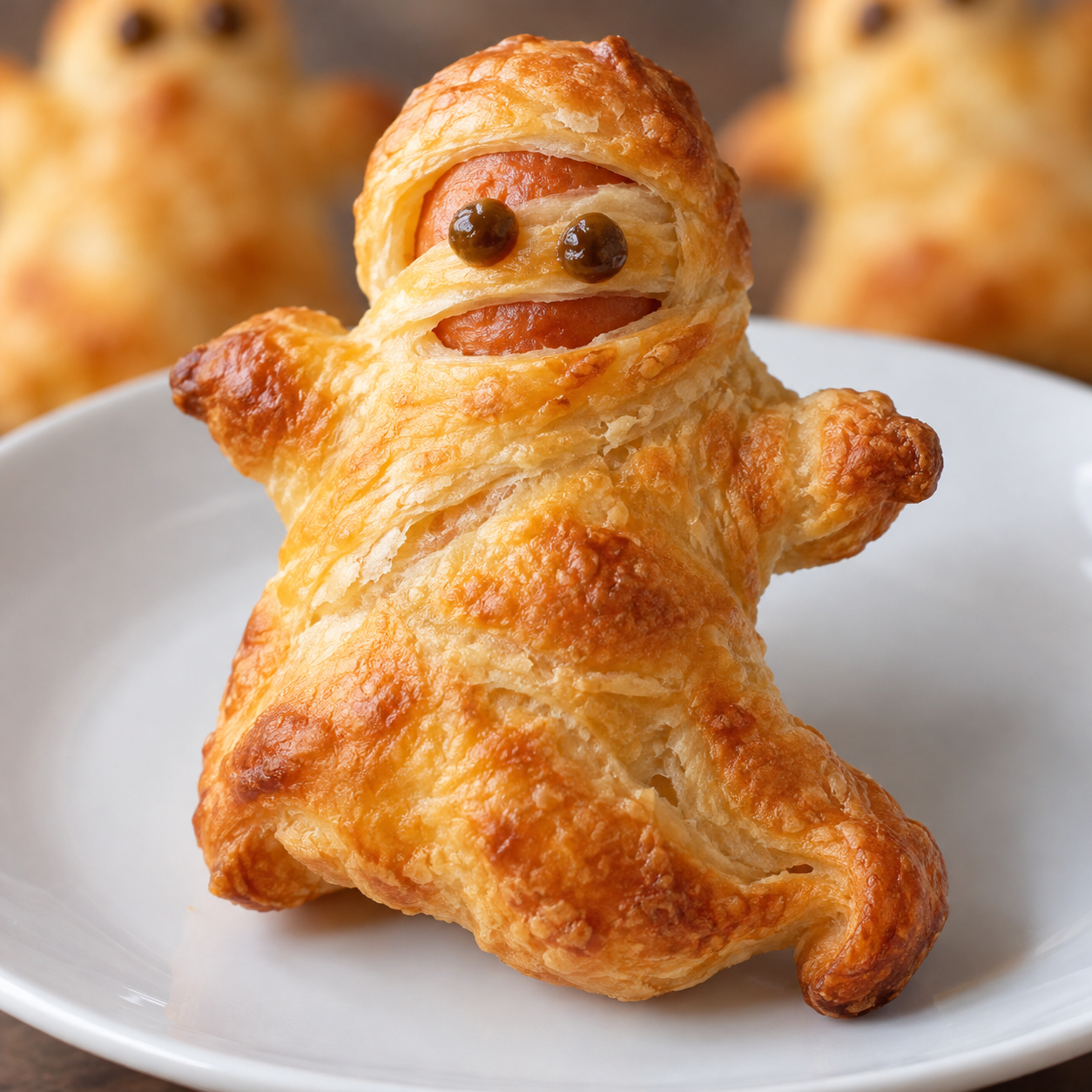
Pigs in a blanket get a Halloween costume in this version. The dough and cocktail sausages stay the same, but each roll gets a loose tail of dough left to dangle and drape, and two small dots of mustard turn it into a ghost face once it bakes.
The shape is the whole trick. Instead of wrapping the dough tight around the sausage, you leave two or three inches hanging past the end. That extra length puffs and curls in the oven into something that actually reads as a little ghost.
This is a fast party snack built from a tube of dough and a bag of cocktail sausages. Assemble a tray while the oven heats, and you can have a platter of ghosts in well under an hour.
The Five-Ingredient Ghost Lineup
This recipe runs on a few convenience staples, so quality matters more than quantity here. Pick up a tube of refrigerated crescent dough and a package of fully cooked cocktail sausages, and the rest comes from the pantry.
If you enjoy this recipe, you may also like Cheesy Fried Broccoli Bites.

- Crescent roll dough. One tube (about 8 ounces/227g, 8 triangles). It forms the ghost's body and the draping tail, and bakes up flaky and golden.
- Cocktail sausages. One package (about 14 ounces/396g, roughly 16 pieces), patted dry. These come fully cooked, so baking just warms them through and crisps the dough around them.
- All-purpose flour. A tablespoon for dusting the counter. It keeps the dough from sticking as you cut and stretch the strips.
- Yellow or Dijon mustard. Two to three tablespoons. Dotted on with a toothpick after baking, it becomes each ghost's pair of eyes.
- Egg. One, beaten, optional. A light brush of egg wash deepens the golden color on the dough, though the rolls bake up fine without it.
- Parchment paper. Lines the baking sheet so the draping tails don't stick as they crisp.
For storage details after serving, the USDA leftovers and food safety guidance.
Shaping And Baking The Ghosts
- Heat the oven. Preheat to 375°F (190°C) and line a baking sheet with parchment paper.
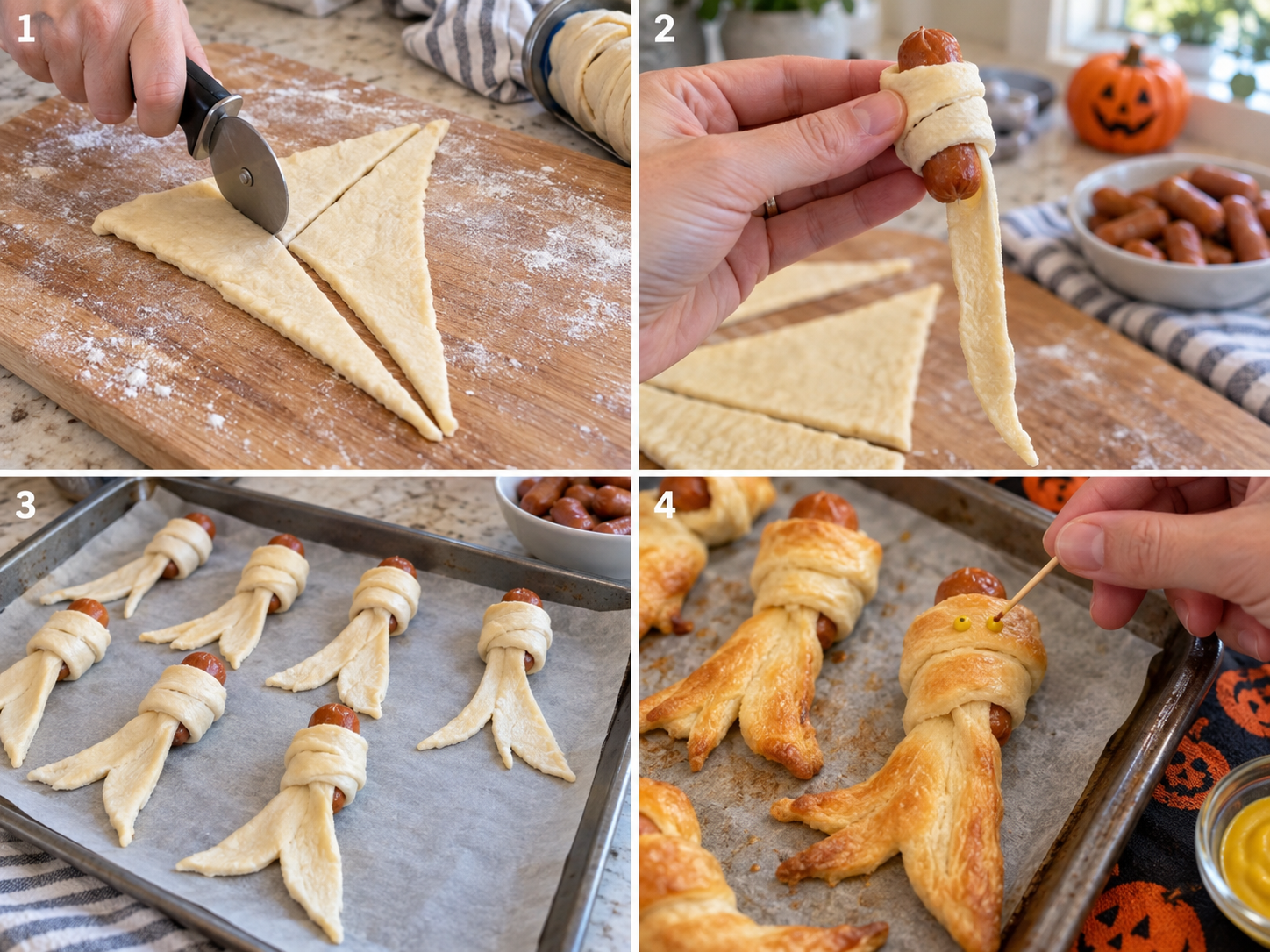
- Cut the dough. Unroll the crescent dough and separate it along the perforated lines into 8 triangles, then cut each triangle lengthwise into 2 long, narrow strips for 16 strips total.
- Prep the sausages. Pat the cocktail sausages dry with a paper towel so the dough grips them instead of sliding off as you wrap.
- Wrap each sausage. Starting about a third of the way down from the top, wind a dough strip around the sausage in a loose spiral, then stop and leave 2 to 3 inches of dough hanging past the bottom, uncovered, so it drapes down like a ghost's tail.
- Arrange and brush. Set the wrapped sausages seam-side down on the baking sheet, gently fan out the dangling tail of each one so it lies flat, then brush lightly with beaten egg if using.
- Bake until golden. Bake for 12 to 15 minutes, until the dough is golden brown and the sausages are heated through.
- Add the faces and serve. Let the ghosts cool for 2 to 3 minutes, dip a toothpick in mustard to dot on two small eyes near the top of each one, then serve warm.
If you enjoy this recipe, you may also like Mini Meatball Cupcakes.
Getting The Ghost Shape Right
The difference between a cute ghost and a plain sausage roll is restraint. Wrap the dough too tightly or too far down the sausage and you lose the tail that makes the shape read as a ghost instead of a snack. Leave two to three inches of bare dough past the end of the sausage and let gravity do the rest.
Before it goes in the oven, splay that loose end out flat on the parchment instead of letting it curl back under the sausage. Flat dough crisps into a wavy, draping shape as it bakes, while bunched dough just puffs into a lump.
If a strip tears while you wrap it, pinch the ends together and keep going. A visible seam disappears once the dough puffs and browns.
Why Fully Cooked Sausages Matter
Little smokies and cocktail sausages sold for this kind of recipe are already fully cooked at the plant, so baking them wrapped in dough is really a reheating step. The goal is to get them hot all the way through, not just golden on the outside.
The USDA's food safety guidance for hot dogs and sausages calls for reheating fully cooked sausages until they're steaming hot throughout, and treating them like any other perishable food once they're out of the fridge: no sitting at room temperature for more than two hours (USDA hot dog and sausage food safety guidance). Twelve to fifteen minutes in a 375°F oven comfortably clears that bar for sausages this small.
Handling The Raw Dough Safely
Refrigerated crescent dough is raw flour and raw dough until it's baked, and raw flour isn't a ready-to-eat food even though it looks harmless rolled up in a tube. The FDA notes that turning grain into flour doesn't kill bacteria like Salmonella or E. coli that can turn up in raw dough, and that cooking is the only way to be sure it's safe (FDA guidance on handling flour and dough safely).
That matters here because this is exactly the kind of recipe kids like to help assemble. Skip tasting the raw dough scraps or playing with the trimmed-off bits, and wash hands and the work surface after handling the raw dough and sausages.
Swaps For Different Diets
This recipe bends easily without losing its shape. Swap in small chicken or turkey cocktail sausages for a lighter version, or small plant-based sausage links for a vegetarian batch. A few grocery freezers carry dairy-free crescent-style dough if you're avoiding butter, though labels vary.
Mustard is the easiest face option because it's already in most kitchens, but it's a listed allergen for some guests. Black sesame seeds or two tiny dots of ketchup work just as well, and the rolls taste fine with no face at all. For gluten-free guests, a gluten-free crescent-style dough works, though it can bake a little faster, so watch the color rather than the clock.
Make It Ahead For A Party
Wrap the sausages up to a day ahead and keep the tray covered in the fridge, then bake fresh right before guests arrive so the dough stays warm and the tails stay crisp. Baked ghosts reheat well too: a few minutes in a 350°F oven brings the texture back far better than a microwave, which tends to leave the dough soft.
Leftovers keep in an airtight container in the fridge for up to three days. Add mustard eyes only to the pieces you're serving right away, since they can dry out sitting in the fridge overnight, and pipe on fresh dots for the next round.
Frequently Asked Questions
- → Can I make these ghost sausage rolls ahead of time?
Yes. Wrap the sausages in dough up to a day ahead and keep the tray covered in the fridge, then bake them right before serving so the dough stays flaky. Add the mustard eyes after baking, not before.
- → What can I use instead of mustard for the eyes?
Black sesame seeds or two tiny dots of ketchup both work as a stand-in. Mustard is a common allergen, so it's worth offering an alternative if you're serving a crowd.
- → Can I use regular cocktail sausages instead of little smokies?
Either works, since they're roughly the same size. If you can only find larger sausage links, cut them into two-inch pieces first so the dough-to-sausage ratio stays the same.
- → Why didn't my ghost tails curl the way I wanted?
Bunched or rolled-up dough tends to puff into a lump instead of a draping tail. Lay the loose end flat against the parchment before baking so it crisps into a wavy, open shape.
- → Are these rolls gluten-free or vegetarian?
Not as written, since standard crescent dough contains wheat and the filling is meat. Swap in a gluten-free crescent-style dough and small plant-based sausage links if you need either version, and watch the bake time since both can cook a little faster.
- → How should I store and reheat leftovers?
Keep baked rolls in an airtight container in the fridge for up to three days. Reheat in a 350°F oven for a few minutes to bring back the crisp tails, rather than the microwave, which softens the dough.