

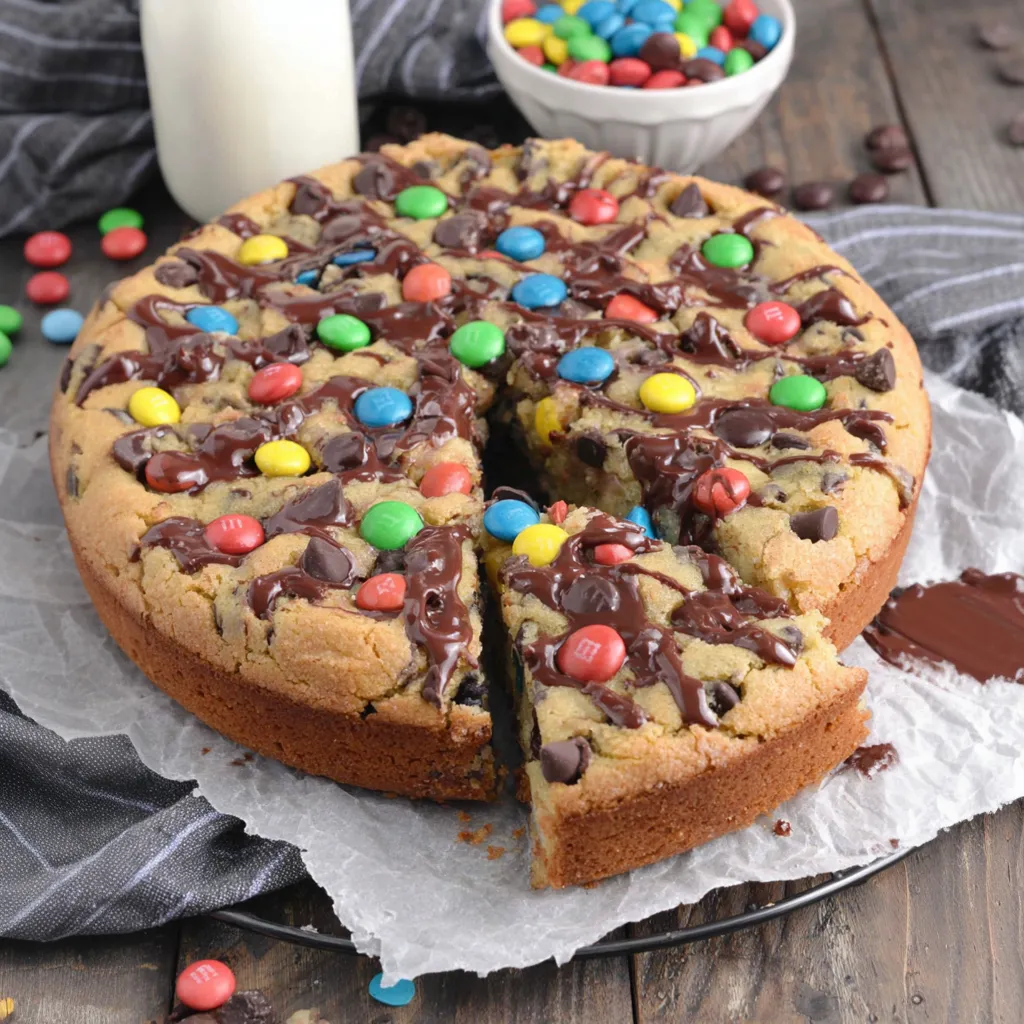
Chocolate chip cookie cake gives you the crisp rim of a cookie and the soft, chewy center of a blondie in one large round dessert. Semisweet chocolate and colorful candy pieces run through the dough, while extra candy pressed on after baking keeps the top bright and polished.
This version fills a 14-inch deep pizza pan and cuts into 16 wedges. The dough is mixed like classic drop cookies, but even spreading and careful timing matter more in a single large layer. Pull the cake when the center is set yet still soft, then let the pan finish the work as it cools.
Ingredients for Chocolate Chip Cookie Cake
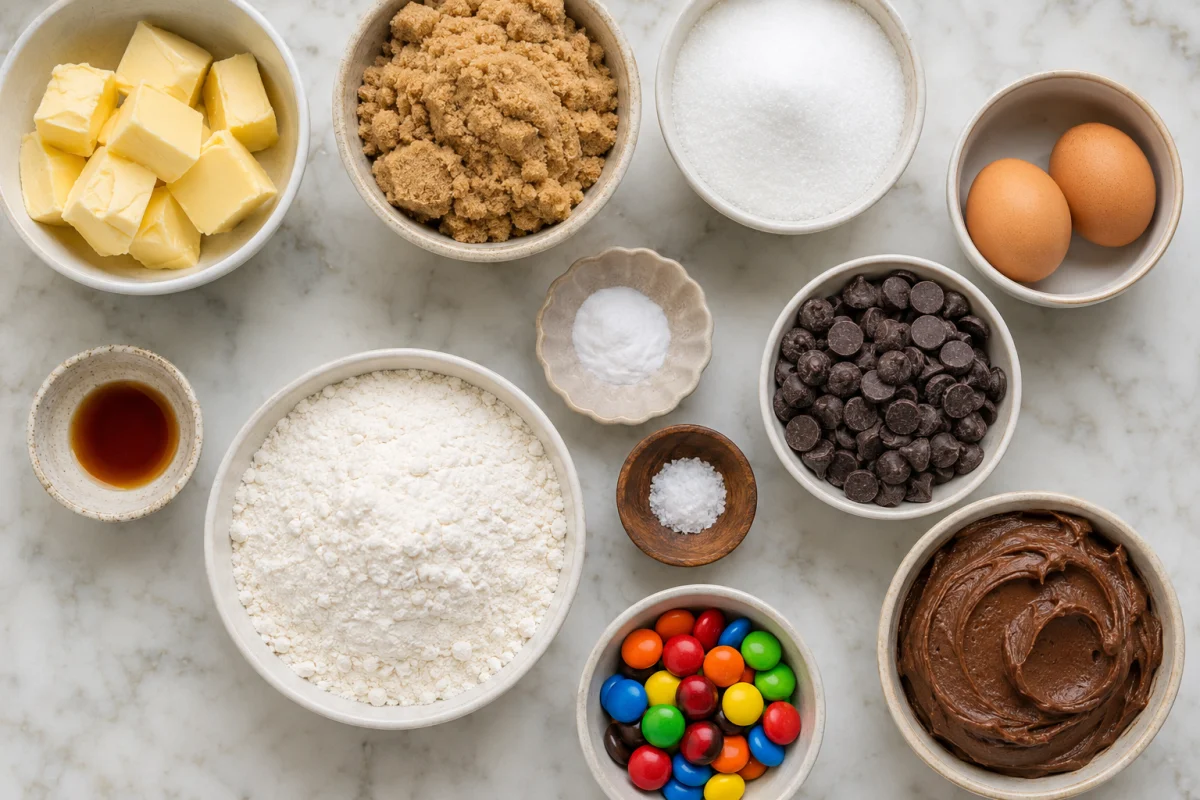
Use 1 cup room-temperature unsalted butter, 1 cup packed brown sugar, 1/2 cup granulated sugar, 2 large eggs, and 2 teaspoons vanilla. The dry mixture needs 2 cups plus 2 tablespoons all-purpose flour, 1 teaspoon baking soda, and 1/2 teaspoon salt.
Fold in 2 cups semisweet chocolate discs or chips and 1/2 cup candy-coated chocolates. Reserve another 3/4 cup candy pieces for the warm surface. Chocolate frosting and mini candies are optional for decorating after cooling.
If you enjoy this recipe, you may also like Cranberry Cake.
How to Make a Giant Cookie Cake
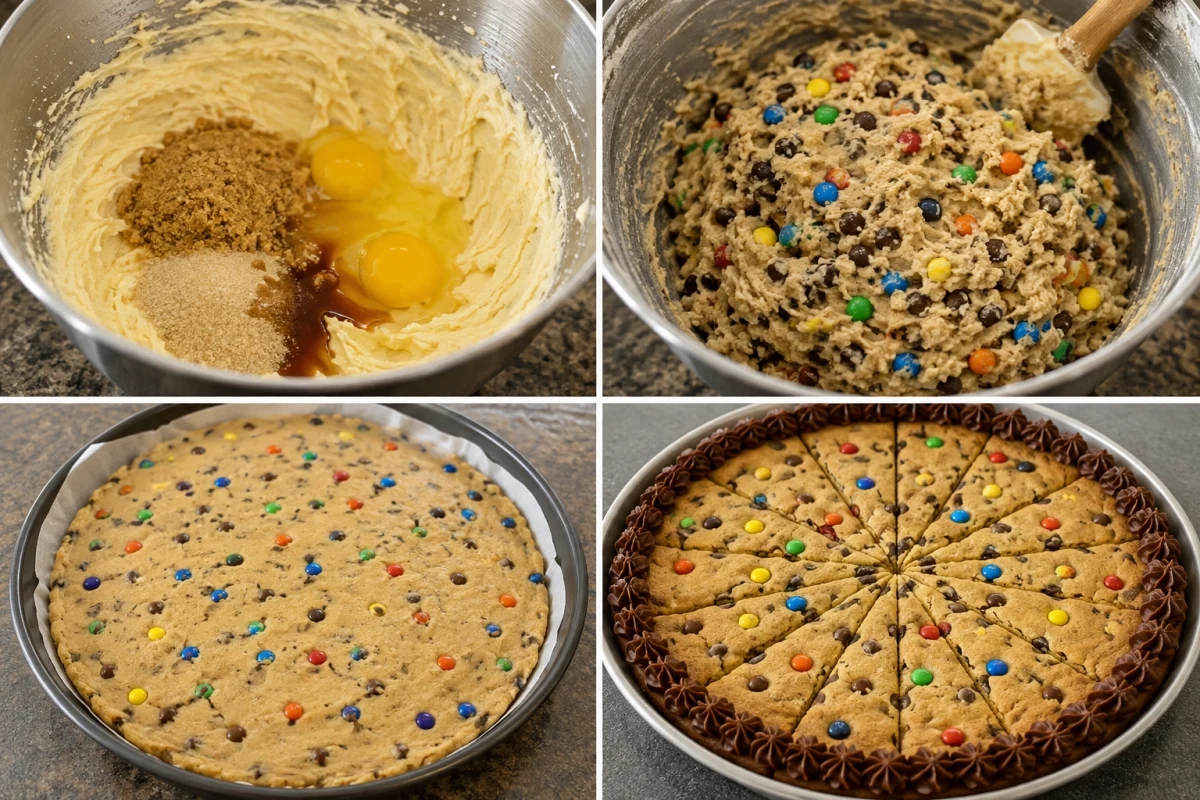
- Prepare the pan. Heat the oven to 375°F. Line a 14-inch deep round pizza pan with parchment and grease the paper and sides.
- Cream. Beat butter with both sugars for 2 to 3 minutes, until lighter and fluffy.
- Add liquids. Beat in eggs one at a time, then add vanilla.
- Add dry ingredients. Mix in flour, baking soda, and salt only until combined.
- Fold in chocolate. Add chocolate pieces and 1/2 cup candy-coated chocolates.
- Spread. Press dough into one level layer, reaching the edges without compacting it heavily.
- Bake. Bake 20 to 25 minutes, until the rim is golden and the center is set but soft.
- Finish. Press reserved candies into the warm top. Cool completely before removing, frosting, or slicing.
For storage details after serving, the USDA leftovers and food safety guidance.
Use a Deep, Wide Pan
A 14-inch deep pizza pan gives this quantity of dough the intended thickness. A shallow pizza screen cannot contain the soft dough, and a smaller pan creates a thicker center that requires different timing. Measure the upper inside diameter if the pan size is uncertain.
Parchment protects the base, while grease along the sides helps the edge release cleanly. Leave enough parchment to cover the bottom without tall wrinkles, which can distort the round shape.
If you enjoy this recipe, you may also like Creamy Blueberry Cheesecake.
Bring Butter to the Right Temperature
Properly softened butter bends under finger pressure but does not look shiny or melted. Cold butter will not aerate with sugar; overly warm butter makes the dough loose and encourages a greasy, flat cake.
Cut butter into even pieces and let it stand at room temperature. Avoid microwaving until partially melted. If it becomes too soft, refrigerate it briefly before mixing. The correct temperature gives the finished cake a tender crumb with a defined outer rim.
Cream Butter and Sugars Thoroughly
Beat butter, packed brown sugar, and granulated sugar for a full 2 to 3 minutes. The mixture should become uniform and slightly paler. This step dissolves some sugar and incorporates small air pockets that keep the dense dough from feeling heavy.
Scrape the bowl and beater before adding eggs. Dense butter often clings at the base. Brown sugar supplies moisture and chew, while white sugar helps the outer edge become crisp.
Add Eggs One at a Time
Mix the first egg until its streaks disappear before adding the second. Gradual mixing helps the fat and liquid form a smooth emulsion. Follow with vanilla and scrape the bowl again.
If the mixture looks slightly curdled, it is usually because the eggs were cold. Continue mixing briefly; the flour will bring it together. Do not compensate with extra flour, which would dry the cake.
Measure Flour Lightly
Spoon flour into the measuring cup and level the top, or weigh it when possible. Scooping directly from a packed container can add considerably more flour than intended. The extra 2 tablespoons in the recipe provide structure for a sliceable large cookie.
Whisk flour, baking soda, and salt separately for the most even distribution, then add them on low speed. Stop once the last pale streak disappears. Overmixing develops gluten and makes the cooled cake tough.
Distribute Mix-Ins Evenly
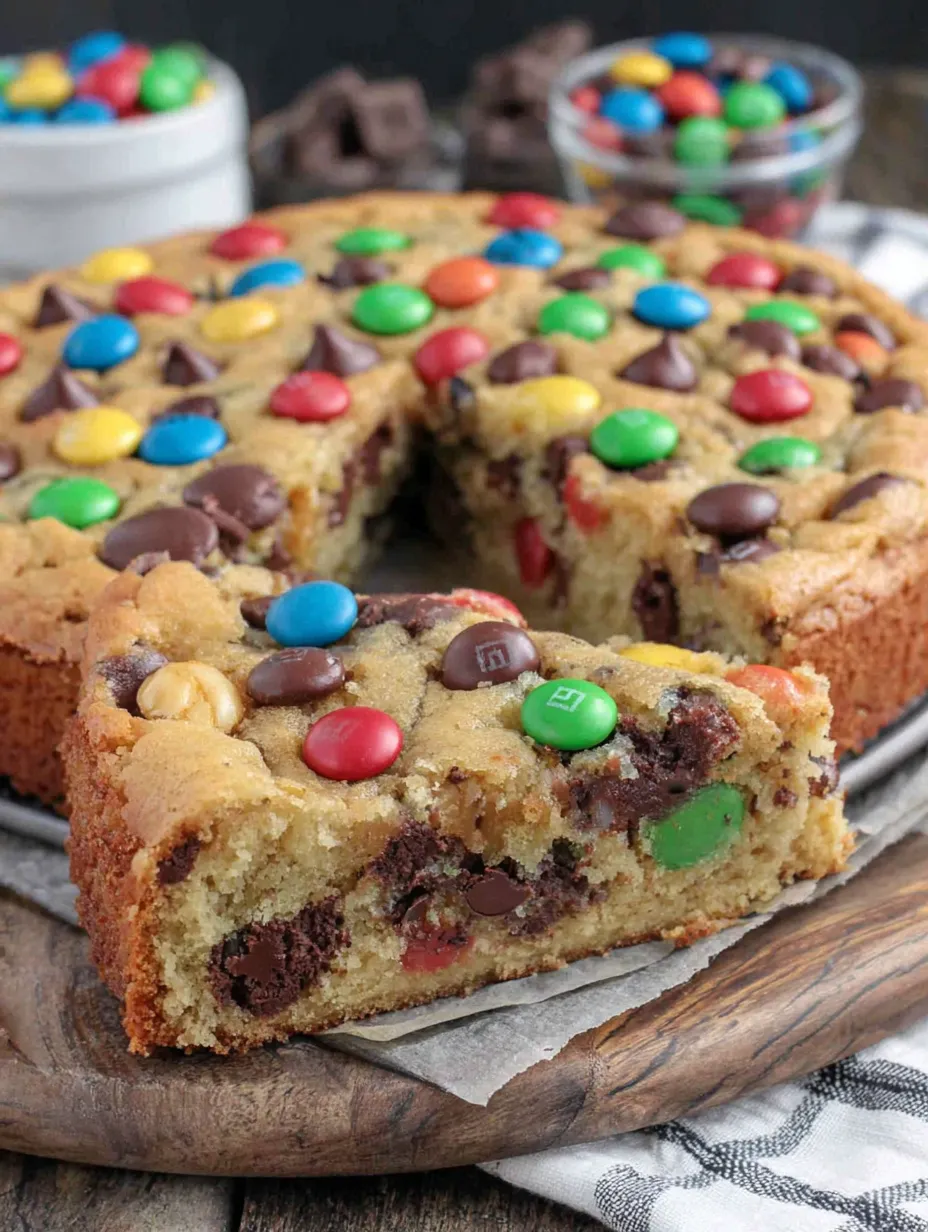
Use semisweet chips or flat chocolate discs in the dough. Discs create broader melted pockets, while chips hold their shape. Fold them in with 1/2 cup candy-coated chocolates using a sturdy spatula.
Reserve the larger decorative portion rather than adding everything to the dough. Candy shells can crack or lose color in the oven; pressing them into the warm surface creates a cleaner top. Keep the mix-ins evenly spread so every wedge receives chocolate.
Spread Without Compressing
Drop the dough around the prepared pan in several portions before spreading. This is easier than pushing one large mound all the way to the edge. Use an offset spatula or lightly greased fingertips.
Aim for uniform thickness, especially where the center meets the outer ring. Thin edges burn before a thick center sets. Smooth the surface without pressing so firmly that the air created during creaming is lost.
Bake by Visual Cues
Start checking at 20 minutes. The circumference should be golden, the top should look dry, and the center should no longer ripple when the pan moves. A toothpick may pick up melted chocolate, so it is not always a useful test.
Ovens and dark pans vary. Rotate once only if one side colors faster. Expect the center to rise slightly and settle as it cools; that change contributes to its chewy texture.
Decorate at Two Different Times
Press the reserved candy pieces onto the surface immediately after the pan leaves the oven. The warm dough grips them as it firms. Use gentle pressure so the center is not compressed.
Wait until completely cool before piping frosting. Warmth melts butter-based frosting and creates oily marks. A simple shell border defines the edge without making every bite overly sweet. Add mini candies to the frosting while it is still soft.
Cool Before Removing and Cutting
Let the cookie cake cool fully in its pan. A warm giant cookie is too flexible to lift and can crack across the middle. Once firm, loosen the edge with a thin spatula and use the parchment to assist the transfer.
Cut with a long sharp knife into quarters, then divide each quarter into four wedges. Wipe the blade between cuts when chocolate is very soft. Small wedges are appropriate because the cake is rich.
Storage and Freezing
Store the cooled cake tightly covered at room temperature for up to four days. Place parchment between individual wedges so frosting and candy do not stick. Refrigeration firms the butter and is unnecessary unless the chosen frosting requires it.
Freeze unfrosted wedges for up to two months. Wrap separately, thaw at room temperature, and add frosting after thawing. Briefly warming an unfrosted piece restores soft chocolate pockets.
Troubleshooting
- Dry cake: Measure flour lightly and remove the pan while the center is still soft.
- Greasy surface: Butter was too warm or the dough was under-mixed.
- Raw middle: The layer was uneven or the pan was too small.
- Hard edge: The pan may be dark or the cake baked too long.
- Cake breaks on transfer: Let it cool completely in the pan.
Conclusion
Cream softened butter with brown and white sugar, beat in eggs and vanilla, then add flour, baking soda, and salt. Fold in chocolate and some candy pieces, spread evenly in a prepared 14-inch pan, and bake at 375°F until golden at the edge but soft in the center. Decorate and cool completely.
Frequently Asked Questions
- → How do I know when a cookie cake is done?
The edge should be golden and the center should look set but remain soft. It continues cooking as it cools in the pan.
- → Can I bake cookie cake in a smaller pan?
A smaller pan makes a thicker cake and changes the baking time. For this quantity, a 14-inch deep round pan gives the intended result.
- → Why did my cookie cake turn out dry?
Too much flour or overbaking are the usual causes. Spoon flour into the cup and remove the cake before the center feels firm.
- → Can chocolate chip cookie cake be frozen?
Yes. Freeze unfrosted wedges for up to two months, thaw at room temperature, and decorate after thawing.